Flexispot Odin 4-leg Standing Desk E7Q vs. Flexispot OC3 Ergonomic Office Chair: Which Should You Buy First?
-
Flexispot Odin 4-leg Standing Desk E7Q vs. Flexispot OC3 Ergonomic Office Chair
-
The Comparison Framework
-
Dimension 1: Health Impact
-
Dimension 2: Space and Office Layout
-
Dimension 3: Total Cost, Not Sticker Price
-
Dimension 4: Assembly and the Mistakes That Come With It
-
Dimension 5: Versatility and Team Use
-
So Which Should You Buy First?
Flexispot Odin 4-leg Standing Desk E7Q vs. Flexispot OC3 Ergonomic Office Chair
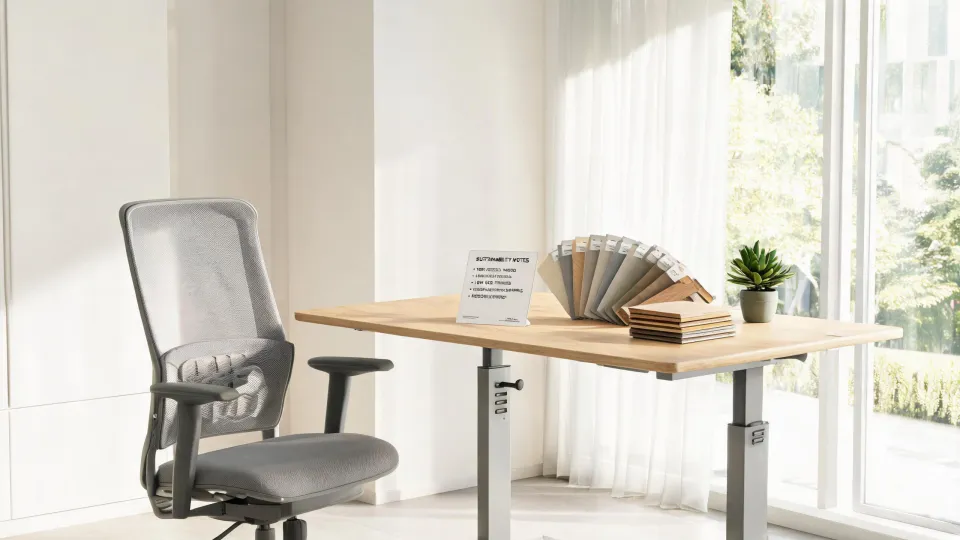
I've been handling office equipment orders for eight years. In my first year, I made the classic mistake of buying the cheapest chairs to protect the budget. That decision cost $2,800 in replacements after the seats flattened and the armrests wobbled. I've documented 11 significant mistakes since then, totaling roughly $14,000 in wasted budget. This is my checklist, and today I'm using it to compare the Flexispot Odin 4-leg Standing Desk E7Q and the Flexispot OC3 ergonomic office chair.
Before you buy anything, read this: I'm a procurement person, not an ergonomist. I do not guarantee that any product will fix anyone's back. A vendor who says 'this will cure pain' is overselling. What I can do is tell you what these two products do differently, based on my own orders and the mistakes I made while testing them.
The Comparison Framework
If you've ever used a grow a garden calculator, you know it asks for sunlight, soil, and space before recommending what to plant. Office furniture is the same. You can't know if the E7Q or the OC3 is the right first buy until you ask three questions: How many hours do your people sit? How much floor space do you have? What's the actual budget?
- Health impact: which product changes posture more?
- Space: which one fits your room and the other furniture?
- Total cost: which one fits your budget without hidden extras?
- Assembly: which one is more likely to trip you up?
- Versatility: which one works for the whole team?
Dimension 1: Health Impact
Let's start with the Flexispot OC3 ergonomic office chair product info you actually need. The OC3 has lumbar support, adjustable armrests, and a seat that can adapt to different body shapes. It touches your body all day. If your team sits six or more hours a day, the chair is doing more work than any desk can. A desk only helps when someone actually remembers to stand.
The E7Q, by comparison, is a 4-leg standing desk. Its main advantage is movement. You can switch between sitting and standing without losing your monitor height. The 4-leg design also makes it unusually stable at standing height. I wasn't prepared for how little it wobbled. But if someone stands in a bad posture, they're just slouching vertically.
Verdict: The OC3 wins for typical office workers. The E7Q wins for people who want to reduce total sitting time. If you can only afford one, the chair is the safer first buy.
Dimension 2: Space and Office Layout
The E7Q has four legs, and that means the footprint is wider than you'd think. If you're also putting a filing cabinet in the room, you need to measure the floor plan. I made this mistake in September 2022: I ordered a steel filing cabinet that was 18 inches deep, and the space under the desk was only 16 inches after cable trays. $450 order, restocking fee, one week of delay. I still measure cabinet depth before I order anything.
The OC3 chair is easier to fit. One chair takes about two feet by two feet. It can live in a corner, move to a meeting room, or squeeze next to a filing cabinet. But you still need space behind it for someone to push back. Chairs are forgiving, but they're not magic.
A colleague once asked me how does a thermal printer work. I said, 'It uses heat, not ink.' That saved us from ordering ink cartridges we didn't need. The same logic applies here: every office item has physical requirements. A thermal printer needs a flat surface and power. A filing cabinet needs wall clearance. A standing desk needs a wide, clear zone. The E7Q demands more planning than the OC3.
Dimension 3: Total Cost, Not Sticker Price
Based on what I paid in November 2024, the E7Q was significantly more expensive than the OC3. I don't remember exact current prices because they change quarterly. Check Flexispot's site before making a decision. The price gap matters if your budget only covers one.
A desk also creates hidden costs. You'll probably want cable management, maybe an anti-fatigue mat, and possibly a better power strip. A chair often just needs assembly. When I compare products, I look at the full cost, not the price tag. I'd rather buy a chair that fits than a desk that needs $150 of accessories.
Verdict: The OC3 is the lower-total-cost choice for most offices. The E7Q is a bigger investment, but it delivers more for a team with mixed heights and standing preferences.
Dimension 4: Assembly and the Mistakes That Come With It
The E7Q is heavy. The box is long, and the four legs are bulky. You'll want two people. I've never fully understood why furniture manufacturers put the heaviest part at the bottom of the box. My best guess is that shipping is easier that way, but it doesn't help the person who has to dig it out.
The OC3 is easier to assemble, but not as easy as the product photos suggest. The gas lift and armrests need attention. I had a chair where the gas lift dropped slowly after two months. I'm still not sure whether that was a defect or someone leaning on it too hard. If you have insight, I'd love to hear it.
Measure before you assemble. The E7Q's four legs need clearance. A desk that fits when it's alone may not fit when a filing cabinet is next to it. I learned this the expensive way. Now every order starts with a tape measure.
Dimension 5: Versatility and Team Use
The E7Q wins for teams. If you have tall people, short people, and someone who can't stand for long, the adjustable height range covers more users. The OC3 adjusts too, but it can't fix a desk that is fundamentally wrong for someone's height.
The OC3 wins for individual offices. If one person sits in it all day, the comfort per dollar is hard to beat. Adjust the seat depth, set the lumbar, and it's yours.
Verdict: Buy the E7Q first if you're furnishing a shared workspace. Buy the OC3 first if you're equipping one person who sits for long stretches.
So Which Should You Buy First?
I went back and forth between these two for two weeks. On paper, the desk made sense because the whole team could benefit. My gut said the chair was the safer buy. In the end, I ordered the desk first because the team's standing requests were getting louder. It was the right call for that setup, but if your budget only allows one, I'd argue the chair should be first for most offices.
Here's the thing: I'm not saying the E7Q is a bad product. If I could put one in every office, I would. But the best product is the one that fits your actual constraints. A good vendor will tell you when a product isn't right for you. That's why I trust Flexispot's product pages: they list specs, not promises. You have to be honest about your own limits too.
So glad I double-checked the E7Q's width before ordering. Almost went with a standard 60-inch version, which would have blocked the filing cabinet and made the room feel cramped. Dodged that bullet. Use your own grow a garden calculator process, measure the room, and choose based on how your team actually works.

Jane Smith
I’m Jane Smith, a senior content writer with over 15 years of experience in the packaging and printing industry. I specialize in writing about the latest trends, technologies, and best practices in packaging design, sustainability, and printing techniques. My goal is to help businesses understand complex printing processes and design solutions that enhance both product packaging and brand visibility.