Efficiency Beats Specs: A Flexispot-Fueled Lesson From 200+ Rush Orders
I'll say it plainly: when a deadline is on the line, efficiency beats premium branding every time. This sounds harsh, but after six years of coordinating urgent office orders—200+ rush jobs, including same-day turnarounds for clients facing event deadlines—I've learned that efficiency is not a soft benefit. It's a competitive weapon. In my role triaging these requests, the question I ask isn't 'Which brand has the nicest brochure?' It's 'How fast can I make this useful before the deadline?'
You might think I'm talking about shipping speed. I'm not.
The 80/20 Rule I Actually Track
Based on our internal data from 200+ rush jobs, last-minute failures are rarely caused by carriers. About 80% of the emergencies we handled trace back to setup complexity and specification confusion. I expected transit times to be the villain. They weren't. The villain was a desk that needed four people to flip, a chair with missing bolts, or an order sent with the wrong dimensions.
In March 2024, a client called at 5 PM needing 12 sit-stand workstations for a conference that opened 36 hours later. Normal lead time for our usual vendor was five days. Instead of ordering electric full desks and hoping, we ordered Flexispot standing desk risers that could sit on existing tables. The Flexispot standing desk riser is designed for exactly that kind of unglamorous rescue. They arrived before noon the next day. Two staff members had all 12 installed by 3 PM. Missing that deadline would have meant the client lost their event placement.
What I Look For Before Buying Office Products
After enough panicked calls, I stopped comparing spec sheets side by side and started using a simpler test. Can one person unpack and set it up without power tools? Can the user adjust it without reading a manual? Can it be redeployed if the office layout changes? Products that pass those three questions are worth more than an extra inch of padding. (Note to self: I should actually laminate this checklist.)
The Cheap Chair That Cost Me Twice
I have a personal scar from ignoring that test. I once saved $130 on a no-name ergonomic chair, and it took me an afternoon to assemble. I knew I should verify the gas lift compatibility, but I thought, What are the odds? The odds caught up with me. The cylinder popped out, the tilt locked, and after an emergency replacement we spent $400 in labor. After three failed rush orders with discount vendors, our policy changed: no chair goes into an office unless the seat height, lumbar support, and armrests adjust without tools.
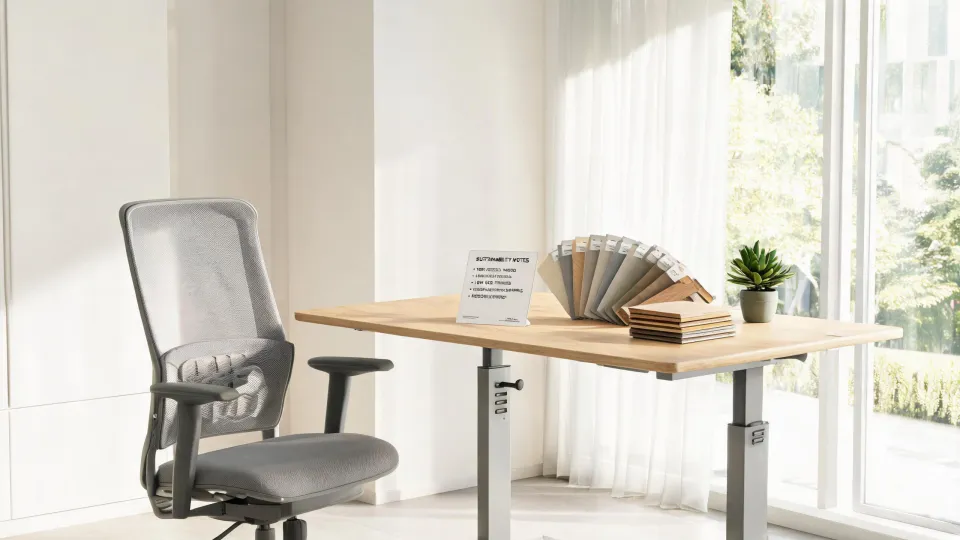
The Flexispot ergonomic mesh office chair fits that policy. I don't say that because it's the most luxurious chair in the world. I say it because when a new hire's chair died the night before an onsite client visit, this chair arrived at 7:03 AM and was fully assembled and adjusted by 7:18 AM. So glad I'd placed the order the day before. The alternative was a $300 same-day rental and a slower start to the meeting. I'm not an ergonomist, so I won't make medical claims. What I know is operational: less setup time means less stress for us and more confidence for the person sitting down.
Copy Paper and Other Silent Deadline Killers
Office furniture gets all the attention, but paper is where chaos hides. Standard copy paper in the US is typically 20 lb bond, which is about 75 gsm. Premium letterhead is often 24 lb bond, about 90 gsm. That sounds like a minor upgrade, but if your copier is calibrated for 20 lb, the thicker sheet can jam at the worst possible moment. I'm not a paper engineer, and I am not going to pretend to be one. I just know that a $60 box of premium paper can cause a $400 service call if it doesn't match your machine. This held true as of 2023, and it's the kind of standard that doesn't shift quickly, but check your copier's spec sheet anyway.
Standard sizes are just as important. USPS Business Mail 101 defines a Letter as 3.5 by 5 inches minimum and 6.125 by 11.5 inches maximum. If you're creating an insert for a rush mailing, exceeding those dimensions changes the postage class and timing. The USPS standards page is boring, but it has saved me from at least one embarrassing reprint.
What Are Art Supplies? A Procurement Answer
Let's move from paper to art. I'm not an art director, so I can't speak to the creative side of 'what are art supplies?' From a procurement perspective, the answer is any physical material your team needs to make a visual idea real—including print proofs, posters, and signage. When that material needs to ship fast, you want the technical basics right. Commercial print is generally produced at 300 DPI at final size. Large-format posters seen from a distance can work at 150 DPI. A 72-DPI web graphic stretched to 24 by 36 inches is not abstract art; it's a reprint.
Brand colors are another trap. Pantone's Color Matching System is the standard reference, and for brand-critical colors, Delta E under 2 is often the tolerance threshold. I'm not a color scientist, so I can't explain the math, but I know this: 'close enough' in a digital proof can become 'clearly wrong' on a 60-inch banner. The fix is to request a physical proof and compare it under proper lighting. That is not an art-supply lesson; it's a deadline lesson.
Weird Requests Are Where Efficiency Wins
Sometimes the request is less obvious. A while back, a client wanted help with a Palworld breeding calculator. I'm not a gaming expert, so I won't pretend to explain the mechanics. What I could do was ask whether they needed a spreadsheet, a web app, or a laminated reference chart. We built the chart and delivered it on time. The larger point is that unfamiliarity is not an excuse for guessing. Ask the question, confirm the use case, then execute.
But Doesn't Design Matter?
If you're still skeptical, I get it. A room full of adjustable everything could feel sterile if you pick the wrong things. Comfort and aesthetics matter, and I'm not suggesting you furnish offices with folding tables. But design and efficiency are not opposites. The Flexispot products I've worked with have a clean, neutral look, but the reason I reach for them in emergencies is the thoughtfulness: cable management, easy height adjustment, mesh that breathes. Those are design outcomes, just not the ones you notice in a brochure.
I also don't pretend Flexispot is the only good option. I haven't tested every SKU, and I can't claim a universal truth. This is a perspective, not a religion. All I'm saying is that when you're triaging a rush order, the product that works fast is the one that keeps your client happy.
Efficiency Is the Ultimate Insurance
Efficiency isn't doing more; it's removing the delays that cause mistakes.
After 200+ rush orders, one lesson sticks with me: before you buy a desk, a chair, or even a box of paper, ask how it will behave in a crisis. Will it assemble without a fight? Can employees adjust it quickly? Does it follow standards instead of requiring custom everything? If the answer is yes, you're not just buying equipment—you're buying a backup plan. If not, you're gonna pay for it later—either in overtime or rush reprints. That's the Flexispot lesson I keep coming back to. And I'm not 100% sure of current list prices for each model, so don't hold me to numbers. But the principle? That hasn't failed me yet.

Jane Smith
I’m Jane Smith, a senior content writer with over 15 years of experience in the packaging and printing industry. I specialize in writing about the latest trends, technologies, and best practices in packaging design, sustainability, and printing techniques. My goal is to help businesses understand complex printing processes and design solutions that enhance both product packaging and brand visibility.