Flexispot for Offices: An Admin's Honest Review of the Crank Standing Desk H1 and OC3 Chair
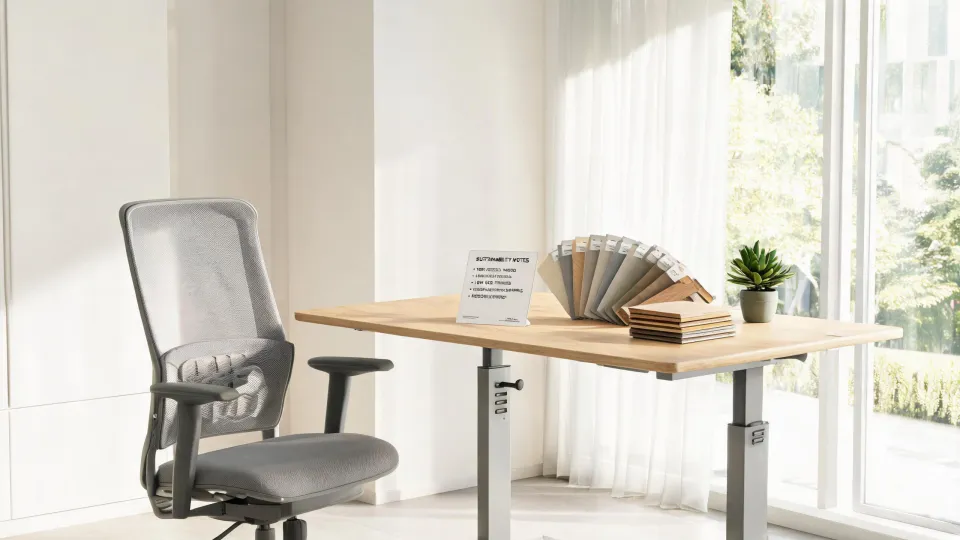
Here's the short answer: I buy Flexispot for our office, and I'd do it again. The Flexispot crank standing desk H1 is my go-to for shared workstations, and the Flexispot OC3 ergonomic office chair is what I order for anyone who sits more than half their shift. They're not the luxury-tier options. They're the 'solid, no-drama, budget doesn't explode' options. For an office administrator who has to answer for every dollar, that's the sweet spot.
I'm the office administrator for a 120-person company. I manage all office and furniture ordering—about $150,000 a year across nine vendors. I've been doing this since I took over purchasing in 2020, and I process 60-80 orders a year. I report to operations and finance. That means I care about smooth process, happy internal customers, and receipts that match quotes. The vendor who couldn't provide proper invoicing cost us $2,400 in rejected expenses. That lesson didn't leave me.
The Flexispot Crank Standing Desk H1: More Than a 'Manual' Desk
Let's be honest: a crank desk sounds like a step backward. We all know electric standing desks exist. But the H1 is not some vintage compromise. It's a steel-frame desk with a smooth crank, no motor to break, and no power cable to plan around. The height range works for our employees from about 5 feet 2 inches to 6 feet 4 inches. I don't have the exact spec sheet in front of me—I'd have to check—but 'adjustable enough' has been true for us.
We put a row of H1s in a training room. They're used by different people every week, so height changes happen maybe once or twice a day. That's exactly where a crank desk makes sense. There's something satisfying about turning the handle and watching the top go where you need it. No hum, no wobble at standing height, no 'waiting for the motor to catch up.' Simple. Crank. Done. Assembly took two of us about 25 minutes per desk. The instructions were clearer than IKEA's, which is another thing I don't take for granted.
The frustrating part? If you're someone who switches from sitting to standing every 45 minutes, the manual crank gets old fast. You'd think it's a harmless little arm workout. By Friday, it's not. For daily height changers, I'd pick a motorized Flexispot model instead. The H1 is for shared desks and conference rooms where you set it and leave it.
The Flexispot OC3 Ergonomic Office Chair: The 80% Chair
If the H1 is the shared-desk solution, the OC3 is the chair I order most. It has adjustable lumbar support, a lockable tilt, adjustable armrests, and a breathable mesh back. It doesn't squeak after a year, which is more than I can say for a chair that cost twice as much from a furniture dealer we no longer use.
I recommend the OC3 for standard office work: email, spreadsheets, video calls, the occasional day-long training. For the staff who sit six to eight hours, it's enough. But let me be clear about limits. If you have employees with specific back conditions or people who need a heavy-duty 24/7 task chair, the OC3 may be the wrong call. It's an 80% chair. The other 20% deserves a specialized ergonomic assessment and a higher-tier chair. I'm not going to name brands—this is about honest fit, not bashing anyone.
Last year we ordered 15 OC3s. One arrived with a loose armrest. Flexispot customer service sent a replacement part without asking me to return the chair or prove anything with photos. That matters more than a glossy brochure. Also, one thing I look for before trusting any ergonomic claims is the FTC. Per FTC guidelines (ftc.gov), advertising claims need to be truthful and substantiated. Flexispot talks about adjustable features and comfort. They don't promise to erase back pain. That's a green flag.
The Requests Nobody Warns You About: Water Calculators, Construction Calculators, and Highlighters
Office buying isn't only desks and chairs. The strangest part of my job is the variety. This year alone:
- HR asked me to find a 'how much water to drink a day calculator' for a wellness newsletter. They wanted something that tells employees how many ounces to drink based on weight and activity. I found one. Most of them use the body-weight formula: about half your weight in ounces, plus more if you're active. I'm not a nutritionist, so I let HR make the final call. Standing desks help with posture; they don't help anyone remember hydration.
- Facilities requested a construction calculator to verify floor load under a row of Flexispot desks. My first thought: 'We're buying desks, not building a bridge.' Turns out they needed concrete and lumber functions for the project. I ordered it. Not ideal, but workable.
- A summer intern asked 'where to apply highlighter' on a purchase order. I realized we'd never had a standard. Now we do: yellow for budget approval, pink for vendor response. It took a clunky first month and a few confused looks, but the system has stuck.
If you've ever had to explain to a VP why an expense was rejected because the invoice didn't match the quote, you know the value of clear process. The highlighter thing is a small version of that. It's about making the paperwork readable for the next person.
Also, when we do have to mail a signed contract, USPS First-Class is still the cheap option: $0.73 for a 1-ounce letter as of January 2025 (usps.com). The more you know.
When Flexispot Isn't the Answer
I don't want to sound like I'm recommending the H1 and OC3 for every office on earth. That would be lazy. Here's where I'd tell you to slow down:
If your office is all private offices with white-glove installation, a crank desk will feel out of place. If you have employees with serious ergonomic needs, don't let a random admin—me, or any blog—pick a chair. Get an assessment. If you run a warehouse, clinic, or 24/7 control room, your furniture has to survive different wear and tear than a consulting office.
This worked for us because we're a mid-size services company with predictable schedules. I don't have hard data on ten-year failure rates for Flexispot. I wish I'd tracked each order more carefully. After maybe 50 units—55? I'd have to check the purchase log—across three years, my sense is they'll hold up. That said, your mileage may vary. The H1 is a shared-desk tool, not a throne. The OC3 is an 80% chair, not a medical device. That's the honest version.

Jane Smith
I’m Jane Smith, a senior content writer with over 15 years of experience in the packaging and printing industry. I specialize in writing about the latest trends, technologies, and best practices in packaging design, sustainability, and printing techniques. My goal is to help businesses understand complex printing processes and design solutions that enhance both product packaging and brand visibility.