The Flexispot Motorized Standing Desk Procurement Checklist (And the Office Tools Everyone Forgets)
-
When to use this checklist
-
Step 1: Identify the actual users
-
Step 2: Measure the space like you're moving furniture, not decorating
-
Step 3: Decide between a full motorized desk and a converter
-
Step 4: Plan for the stuff that will sit on the desk
-
Step 5: Pair the desk with a chair before you order
-
Step 6: Pilot one before you roll out
-
Common mistakes I don't want you to repeat
This checklist is for the person who gets handed office furniture orders and has to make them work. Not for someone buying one desk for a home office. For a team. If you've ever coordinated 12 desks, 20 chairs, and a printing setup in the same month, this is the list I wish someone had given me in 2022.
I've handled procurement for our office for three years now. I've made—and documented—seven significant mistakes, totaling roughly $18,000 in wasted budget. That number still stings. But it gave me a checklist that's caught 36 potential errors in the last 18 months. This one covers a Flexispot motorized standing desk, the Flexispot M7 Series standing desk converter, and the non-glamorous stuff that usually gets ignored until someone needs it.
When to use this checklist
Use it when you're:
- Outfitting a new office
- Replacing existing desks
- Deciding between full sit-stand desks and desktop converters
- Adding equipment to existing desks without redoing the whole floor
There are six steps. None of them are complicated. Step four is the one almost everyone skips.
Step 1: Identify the actual users
First mistake I made: ordering 'standard height adjustable' desks for everyone without asking about how people actually worked. We ended up with a mix of laptop users, one person who already had a converter at home, and two people who never used the standing feature at all.
For a Flexispot motorized standing desk, adjustability is the whole point. The motorized range needs to cover the heights of the people who will sit and stand at it. That means you need more than a guess. Ask for approximate heights. Ask if anyone has any existing ergonomic setup they want to keep. Ask if they'll need monitor arms, because that changes the surface height math.
Checkpoint: Do you have user height ranges and a written note about who needs monitor arms? If not, stop and collect them.
Step 2: Measure the space like you're moving furniture, not decorating
It sounds obvious, but the number of office setups that ignore cable paths is wild. In September 2022, I approved a 60-inch desk for a 55-inch alcove. It fit—barely. But the outlet was behind a cable tray arm, and the height adjust mechanism couldn't lower all the way because the cable got pinched.
Before you choose between a full desk and a converter, measure three things: the physical footprint, the location of power outlets, and the distance to the wall. The Flexispot M7 Series standing desk converter needs to sit on top of an existing desk, so the surface depth matters more than the floor layout.
Checkpoint: Do the length, width, and cabling route work for the specific model you're considering?
Step 3: Decide between a full motorized desk and a converter
This is a real trade-off, and I've been stuck in it before. I went back and forth between the Flexispot motorized standing desk and the M7 converter for two weeks. The full desk gives you a clean room layout and maximum adjustability. The M7 Series standing desk converter costs less and turns your existing desk into a sit-stand station without moving the furniture.
I ended up choosing the converter for 10 of our 14 stations. Reason: our existing desks were less than a year old, and the budget didn't justify replacing them all. It wasn't the ideal setup, but it worked. If you're starting from scratch, a full motorized desk is simpler. If you're upgrading, a converter is usually the faster path.
Checkpoint: Have you written down the cost of the full rebuild vs. the converter route, including installation and training?
Step 4: Plan for the stuff that will sit on the desk
This is the step that gets ignored because it's not about furniture. It's about workflow. A desk is not an island. Your team needs to do things on it, and some of those things are not as pretty as a monitor and keyboard.
For example, our operations person renews jewelry buyback contracts. Her morning routine is: check spot price, open a scrap gold calculator, and confirm the contract value before the market moves. She needs enough desk surface for a keyboard, a phone, a receipt printer, and a physical calculator on the side. The 'small' desk that seemed fine on paper became a daily annoyance.
Another teammate runs pricing experiments. He keeps a p value calculator open in his browser most days because the spreadsheet plugin on his laptop is unreliable. Again, nothing to do with the desk brand. Everything to do with the desk needing to fit the actual work.
And then there's the scanning workflow. The question everyone asks at some point is how to scan a document from printer to computer. It sounds basic. But when you're setting up a new all-in-one printer, the driver, the network connection, and the file destination all need to be checked. We once spent two hours on it because someone bought a printer that didn't support our operating system.
Checkpoint: For each workstation, list the 3-4 objects that will be used daily. Does the desk hold them? Is the scanning software installed and tested?
Step 5: Pair the desk with a chair before you order
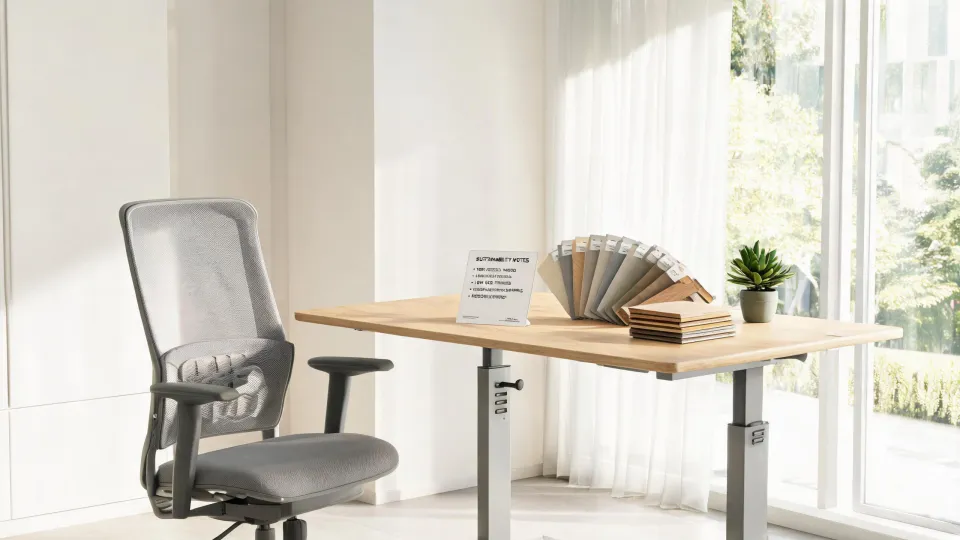
A standing desk without a good chair is a half solution. I'm not an ergonomics specialist, so I can't tell you which chair model is medically right for your team. What I can tell you from a procurement perspective is that you need to think of the desk and chair as one system. If the desk height is set for standing, the chair height for sitting needs to match. If you skip this, the 'sit-stand' setup ends up being just a standing desk with a chair that's too low.
We once used the phrase 'ships as soon as possible' with a supplier. They heard 'whenever convenient.' The desks arrived two weeks later than I expected. The chairs arrived on time. The impossible situation was ours, because we didn't coordinate the delivery windows.
Also, be careful with marketing claims. According to FTC guidelines (ftc.gov), advertising claims about health benefits need to be truthful and substantiated. So when a brand says an ergonomic chair 'relieves pressure,' treat that as a general statement, not a medical guarantee. What matters is whether the armrests adjust, the seat depth is right, and the locking mechanism actually locks.
Checkpoint: Have you synchronized desk and chair delivery dates? Have you confirmed the chair height range works with the desk range?
Step 6: Pilot one before you roll out
This is the discipline that saved us the most money. In Q1 2024, I made a rule: no bulk order until we've tested one full unit first. It caught a problem immediately. We ordered a sample of a desk with a cable tray that hit the drawer of our existing file cabinets. The wire management arm was about an inch longer than the gap between desk and cabinet. On paper, 'standard size' looked fine. In reality, nothing fit.
If you're outfitting a whole office, order one desk, one converter, one chair, and the scanner. Put them in the actual space where they'll be used. Have two different-height people test them. Then place the rest of the order.
Checkpoint: Have you tested the actual equipment with the actual people and the actual room?
Common mistakes I don't want you to repeat
- Ordering before measuring the room and the workflow.
- Choosing a 'motorized desk' but ignoring the cable management system.
- Buying a converter without checking how deep the existing desk is.
- Assuming scanners connect automatically. They don't.
- Forgetting that calculators are workflow tools, not office supply inventory.
What was best practice in 2020 may not apply in 2025. The fundamentals haven't changed—measure, ask, test—but the execution has. Standing desks used to be a premium line item. Now they're expected. The same is true of the practical tools around them. Don't make the setup perfect. Make it testable, and make it boring enough that everyone can just do their job.
Verify current specs and prices on flexispot.com before ordering. And if you're the person doing the setup, take the extra 20 minutes to test the workflow, not just the furniture. It's cheaper than the alternative.

Jane Smith
I’m Jane Smith, a senior content writer with over 15 years of experience in the packaging and printing industry. I specialize in writing about the latest trends, technologies, and best practices in packaging design, sustainability, and printing techniques. My goal is to help businesses understand complex printing processes and design solutions that enhance both product packaging and brand visibility.