Why Total Cost of Ownership (TCO) Made Me Switch to Flexispot Standing Desks (and You Should Too)
-
If you're still comparing only unit prices on standing desks, you're burning money.
-
The $350 trap I fell into (and what it really cost)
-
Hidden costs most buyers ignore (and vendors won't tell you)
- Two Flexispot products that proved TCO in practice
-
But Flexispot isn't the cheapest option – so why choose it?
-
The bottom line: calculate TCO before you buy
If you're still comparing only unit prices on standing desks, you're burning money.
After eight years handling office equipment orders for a mid‑sized tech company, I've made enough mistakes to fill a small warehouse. Twelve significant ones, to be exact – totaling roughly $18,000 in wasted budget. The worst of them? A bulk purchase of cheap electric standing desks in 2019. On paper, they were a steal at $350 each. In reality, the motors failed within six months, the warranty was worthless, and we spent another $200 per desk on repairs and replacements. That's when I stopped looking at price tags and started calculating total cost of ownership (TCO).
The $350 trap I fell into (and what it really cost)
In March 2019, I approved an order for 50 standing desks from an unknown online brand. The unit price was irresistible – half of what Flexispot charged for similar models. What I didn't factor in: $45 per desk for shipping (the advertised free shipping only applied to the first 10), $60 per desk for assembly (our team didn't have the tools), and a 1-year warranty that excluded motor labor. When the first motor died in month 8, the replacement part was covered, but the service call cost $150. By month 18, 12 desks had failed. Total waste: $350 (unit) + $45 (shipping) + $60 (assembly) + $150 (repair) = $605 per desk, and we still had 38 ticking time bombs. That $350 bargain turned into a $30,250 disaster. Compare that to a Flexispot E7 that I later bought for $529 with free shipping, a 5-year warranty, and motor replacements that cost $0 in labor. The TCO calculation was obvious.
Hidden costs most buyers ignore (and vendors won't tell you)
Here's something vendors won't tell you: the advertised price is just the beginning. When I train our new buyers, I give them a checklist that covers five hidden cost buckets:
- Shipping and handling – big, heavy items often come with oversize fees or liftgate charges. Always ask for a delivered price.
- Assembly and setup – unless your team is handy, budget $30–$80 per desk for professional assembly. Some brands include this; most don't.
- Warranty coverage – read the fine print. Many budget desks limit motor coverage to 1 year, while Flexispot offers 5 years on motors and 15 years on frames.
- Downtime costs – when a desk breaks, an employee loses productivity. At $50/hour, a half-day without a working desk costs $200.
- Ergonomic mismatch – a non‑adjustable or poorly designed desk can lead to back pain and repetitive stress injuries. The CDC estimates that workplace musculoskeletal disorders cost employers $20 billion annually in direct costs (cdc.gov, 2023). A quality standing desk isn't just furniture – it's health insurance for your team.
Honestly, I'm not sure why some buyers still compare only unit prices. My best guess is it takes one expensive mistake to learn. Don't wait for yours.
Two Flexispot products that proved TCO in practice
1. Flexispot M7 Standing Desk Converter
If you already have a fixed desk and can't replace it, the M7 converter is the cheapest TCO upgrade you can make. I bought one for our reception area after seeing it reviewed positively. At $199, it's not the absolute cheapest converter – you can find some for $89. But look closer: the M7 has a solid steel frame, dual gas springs that lift 33 lbs easily, and a key lock to prevent theft. The cheap $89 model? Flimsy plastic arm, single gas spring that struggled with a 15‑lb monitor, and no lock. We had to replace it in six months. The M7 is still going strong after two years. That's TCO in action: $199 once vs. $89 twice plus frustration.
2. Flexispot C7 Max Ergonomic Office Chair
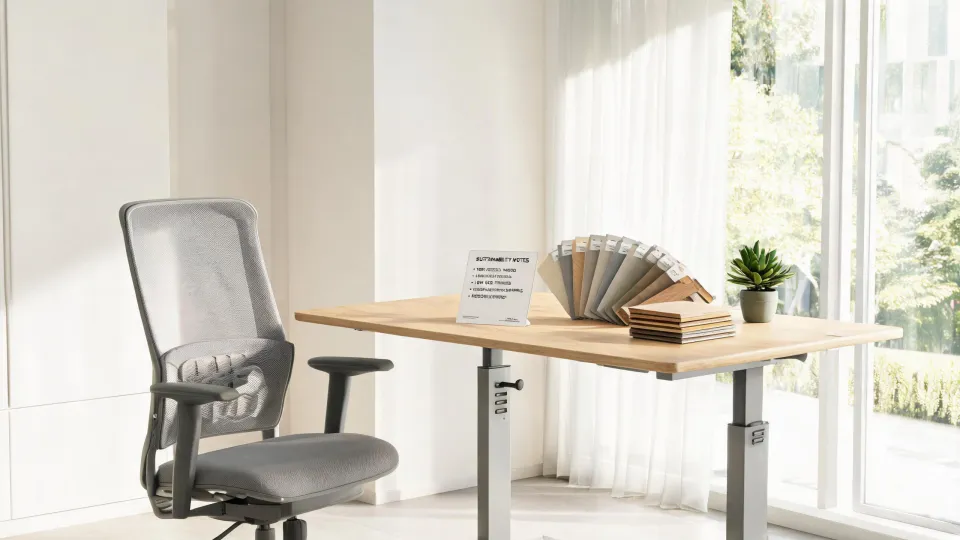
I'll be honest: I was skeptical about spending $599 on a chair when we could get “ergonomic” chairs for $200. Then I sat in the C7 Max. The adjustable lumbar support, 4D armrests, and breathable mesh back aren't just buzzwords – they actually fit different body types. We bought 10 for our customer support team, and after six months, the feedback was overwhelmingly positive. Fewer complaints of back pain, less absenteeism. Compare that to the $200 chairs we previously bought, which started sagging after a year and had zero adjustability. The C7 Max has a 5‑year warranty and replaceable parts. Even if it costs $400 more upfront, over a 5‑year period the per‑year cost is actually lower than replacing a cheap chair every 18 months.
But Flexispot isn't the cheapest option – so why choose it?
I get this question every time. Yes, you can find an electric standing desk for $300 and a “ergonomic” chair for $150. And if you're only planning to use them for a year, go for it. But if you're equipping an office for the long haul, TCO flips the script. Flexispot doesn't lead on price – it leads on durability, warranty, and engineering. The motors are quieter, the desks wobble less at full height, and the customer support actually responds. When I had an issue with a shipment in 2023, they had a replacement part at my door in 48 hours. No questions asked. That kind of service has real value – and it doesn't show up on a price sheet.
One more thing: some people argue that a cheap desk + a separate standing mat is a better deal. But that ignores the time spent switching between standing and sitting setups. A quality electric desk like the Flexispot E7 or EN1 lets you change height with one button, encouraging movement. The cost of not using it? Lost productivity from discomfort. So yeah, you could save $200 upfront. But over three years, the Flexispot owner likely gets more done, feels better, and avoids repair headaches.
The bottom line: calculate TCO before you buy
Whether you're outfitting a corporate office, a home workspace, or even a creative studio where you might paint with acrylics (please don't paint your face – that's a different question), the principle is the same: look beyond the price tag. I've regretted every desk I bought on price alone. I've never regretted a Flexispot purchase.
Start by listing your TCO factors: unit price + shipping + assembly + warranty + expected lifespan + productivity impact. Add a 10% buffer for “oops.” Then compare brands. Flexispot will win in almost every scenario where quality matters. And if you're still not convinced, ask someone who's been burned before – like me. We'll tell you the same thing: pay once for quality, or pay repeatedly for regret.
Pricing accurate as of April 2025. Always verify current rates at flexispot.com.

Jane Smith
I’m Jane Smith, a senior content writer with over 15 years of experience in the packaging and printing industry. I specialize in writing about the latest trends, technologies, and best practices in packaging design, sustainability, and printing techniques. My goal is to help businesses understand complex printing processes and design solutions that enhance both product packaging and brand visibility.