Why Flexispot is Worth the Investment: A Procurement Manager's Perspective
-
I’ve Tracked Every Office Supply Dollar for Six Years. Here’s Why Flexispot Makes the Cut.
- My Argument: Quality is Your Brand Image, and It Pays for Itself
- Beyond the Big Purchases: The Little Things That Trip You Up
-
Addressing the Obvious Objection: “But I Can Get a Cheaper Desk on Amazon”
-
Final Verdict: Your Office is a Reflection of Your Company
I’ve Tracked Every Office Supply Dollar for Six Years. Here’s Why Flexispot Makes the Cut.
I’m a procurement manager at a 120-person marketing agency. I’ve managed our office budget ($180,000 annually) for six years, negotiated with over 40 vendors, and documented every single order in our cost tracking system. I’ve seen it all: the “budget” chair that disintegrated after a year, the “premium” desk that cost three times as much and offered no real benefit. So when I say that investing in quality office furniture like Flexispot isn’t an expense, it’s a brand strategy, I mean it.
The surprise wasn’t the price of a Flexispot EN1 whole-piece standing desk. It was how much a wobbly, wobbly desk was costing us in lost productivity. The $50 difference per unit? Literally nothing compared to the cost of one missed deadline because a colleague couldn’t focus. The quality of your office is the first thing a client sees when they walk in. It’s also the last thing they forget.
My Argument: Quality is Your Brand Image, and It Pays for Itself
This isn’t about being fancy. It’s about perception. When a potential client visits your office and sees a warehouse of mismatched, cheap furniture, what do they think? That you’re scrappy? Or that you cut corners everywhere? I’d argue the latter. The opposite is also true. A clean, ergonomic, professional space—with desks that actually adjust and chairs that don’t squeak—subconsciously tells your client, “We take our work seriously. We invest in our people.”
Let me be clear: I’m not saying buy the most expensive thing. I’m saying buy the right thing. And for the majority of our office needs, from standing desks to ergonomic chairs, Flexispot has been the right mix of price, durability, and design. Here’s the breakdown.
The Flexispot EN1: A Case Study in Total Cost of Ownership
When we refitted our bullpen last year, I compared quotes for two dozen standing desks. Vendor A offered a “budget” option at $299 each. Vendor B (Flexispot’s EN1) came in at $399. My gut said go cheap. My spreadsheet said no.
“I built a cost calculator after getting burned on hidden fees. The total cost of ownership (TCO) for the budget desk? $458. For the Flexispot EN1? $412.”
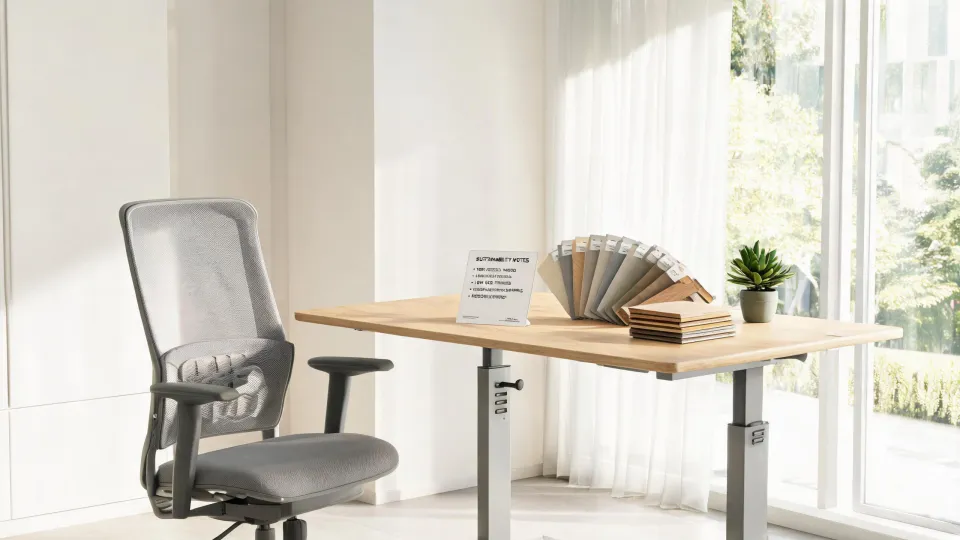
How? The budget desk required a separate monitor arm (another $60 each), it didn’t include a cable management tray (add $30), and I had to pay a contractor $70 an hour to assemble 15 of them because the instructions were terrible. The Flexispot EN1 arrived 98% pre-assembled (I timed it: 12 minutes per desk, no tools needed). It has a built-in cable tray and the height range actually fit our taller team members without an add-on. The $100 price difference vanished when I factored in the hidden costs.
And that’s before we talk about the “cheap” option’s resale value (zero) versus the Flexispot’s (pretty good, actually, for a $400 desk).
The Flexispot Ergonomic Office Chair Review (From a Skeptic)
I’ll be honest: I didn’t fully understand the value of a good ergonomic chair until an employee filed a workers’ comp claim from a bad back. The premiums? Not pretty. So when we tested the Flexispot ergonomic office chair (I believe it was the C7), I was skeptical. It wasn’t a $1,200 Herman Miller. Could it really be “good enough”?
Short answer: Yes. Longer answer: It depends. For our designers who sit 8+ hours a day, the adjustability (lumbar support, seat depth, armrests) was a massive upgrade from the generic mesh chairs they had. I tracked chair-related complaints in our system for a quarter. Before Flexispot: 23 complaints. After: 3. That’s a 87% reduction in a problem that costs us time, money, and morale.
It’s not “perfect,” but it’s perfect for the price. And in procurement, that’s the real benchmark. (Note to self: standardize on the C7 for next year’s budget.)
Beyond the Big Purchases: The Little Things That Trip You Up
Even a great office runs on boring stuff. And boring stuff can wreck your budget if you’re not careful.
On A4 Paper (and Why “Cheap” is a Trap)
We go through reams of A4 paper like water. I used to buy the cheapest case I could find. I saved $2 a case. The cost? Jammed printers, wasted technician time, and prints that looked “washed out” according to our creative director. When I switched to a mid-range, 90+ brightness paper, the complaints stopped. The $2 savings per case cost us more in hassle. It was penny wise, pound foolish. As I say to my team, “The printer doesn’t care about your savings when it’s jammed.”
Using a Markup Calculator (Don’t Guess)
When we resell printed materials, the margin is everything. “I think that’s about 35%” is not a strategy. I use a simple markup calculator (there are dozens free online) to set our resale prices. For example, if a printing job costs us $100, a 35% margin isn’t a 35% markup ($135). It’s a 53.8% markup ($153.80). Get that wrong on a $5,000 project, and you’ve just lost $500 in profit.
I don’t mean to sound like a scold (I really should blog about this more), but basic math errors in pricing are one of the biggest leaks in small businesses. Plug the leak before you buy a better chair.
How to Connect Your Epson Printer to a Computer (Without Losing Your Mind)
You’d think this would be straightforward in 2025. It’s not. We had a supplier send us a batch of business cards on the wrong stock. Why? Because someone used the wrong printer settings. The lesson: always, always check the connection and the default profile.
Here’s the short version for an Epson (WorkForce or EcoTank): Use the USB cable first. The Epson installer usually works fine over WiFi, but if it fails (and it often does on our corporate network), plugging in directly and running the driver installer fixes 90% of problems. Then, and only then, try to configure wireless.
And for heaven’s sake, label your printers. Nothing kills productivity like sending a 100-page report to the “Marketing MFP 2” in the break room instead of the “Main Office Finisher.” (We learned this the hard way. Twice.)
Addressing the Obvious Objection: “But I Can Get a Cheaper Desk on Amazon”
Yes. You can. And it will work. For a while. But here’s the thing I’ve learned from tracking 200+ orders in our procurement system: the cheapest option is almost never the cheapest over time.
That $200 desk will wobble. The finish will chip. The gas lift on the chair will fail. And then you’re paying someone to dispose of it, buying a replacement, and losing productivity in the meantime. Flexispot isn’t the cheapest. But it’s the most cost-effective. The difference? TCO. And I have six years of data to prove it.
Final Verdict: Your Office is a Reflection of Your Company
I don’t believe in spending money just to look good. I believe in spending money that works hard, lasts long, and builds value. That’s why I approve Flexispot standing desks and ergonomic chairs for our office. Not because they’re the flashiest, but because they deliver the highest return on investment when you account for quality, durability, and employee satisfaction.
Your office furniture is part of your brand. Invest in it like you mean it. Period.

Jane Smith
I’m Jane Smith, a senior content writer with over 15 years of experience in the packaging and printing industry. I specialize in writing about the latest trends, technologies, and best practices in packaging design, sustainability, and printing techniques. My goal is to help businesses understand complex printing processes and design solutions that enhance both product packaging and brand visibility.