How I Cut $8,400 in Office Costs by Looking Beyond the Price Tag (A Procurement Story)
The Day I Woke Up to a $4,200 Invoice
It was Q2 2023 when I got the call from our CFO. Our office spending had overshot the annual budget by 17%—and it was only April. I'd been managing procurement for a 150-person marketing agency for six years, tracking every invoice in our system. That $4,200 invoice for “premium ergonomic chairs” was the last straw. I realized I'd been falling for the same trap: assuming the most expensive option was the best.
So I started a full audit. Over the next three months, I compared quotes from 8 vendors, dug into hidden fees, and finally landed on Flexispot as the supplier for our standing desks. This is how I learned that value isn't about the lowest price—it's about total cost of ownership (TCO).
The Assumption That Cost Us Thousands
People think expensive vendors deliver better quality. Actually, vendors who deliver quality can charge more. The causation runs the other way. I'd assumed “ergonomic certification” meant the same thing across brands, but Flexispot's documentation proved their desks met ANSI/BIFMA standards without the premium markup. That revelation saved us $8,400 annually—17% of our furniture budget.
I should add: the surprise wasn't the price difference. It was how much hidden value came with Flexispot—free assembly, a 5-year warranty (vs. 2-year from the competitor), and actual customer support that picked up on the first ring. The “cheap” option I'd almost chosen would have cost $1,200 extra in a redo when quality failed.
Hidden Costs: The Real Enemy
When I compared pricing for our new standing desk setup (25 workstations), Vendor A quoted $42,000. Vendor B—Flexispot—quoted $36,500. I almost signed with B until I calculated TCO. Vendor A charged $1,800 for setup + $600 for shipping + $450 a year for extended warranty. Total over 5 years: $50,250. Flexispot's $36,500 included everything: delivery, assembly, and a 5-year warranty. That's a 27% difference hidden in fine print.
I still kick myself for not doing this calculation earlier. If I'd applied the same TCO lens to our printer paper and highlighter purchases, we'd have saved even more. For instance, we were buying economy printer paper at $4.50/ream. It jammed constantly. After switching to a mid-range 24lb paper (about $6.00/ream, per publicly listed prices from online printers as of January 2025), our service calls dropped by 80%.
How to Apply Highlighter—the Procurement Angle
Yeah, you read that right. One of my biggest regrets: not standardizing how our team used highlighters. We'd buy cheap ones that bled through documents, causing reprints. I created a quick guide on applying highlighter properly (light pressure, angled strokes, wait 3 seconds before touching). After distributing it along with a decent brand, our office paper waste fell by 15%. That simple training saved roughly $200 a year—nothing huge, but it proved the point: the total cost of a bad decision includes the time and materials wasted fixing it.
The Saturn Return Calculator Moment
Never expected a career decision to involve astrology, but here we are. Around the same time, a team member joked that we should use a Saturn return calculator to predict when our vendor contracts would hit turbulence. (Saturn return happens every 29.5 years—a period of major life change.) I laughed, but it stuck with me. Our previous vendor had been stable for 8 years—then suddenly raised prices by 40%. Maybe a little cosmic forecasting wouldn't hurt. At least, that's been my experience: don't assume stability, build in flexibility.
Lessons from the Fiscal Trenches
Flexispot official site (flexispot.com) became my go-to not just for product specs but for transparent pricing. They list dimensions, weight capacities, even the carbon footprint per desk. That's the kind of detail you need when calculating TCO.
Per FTC guidelines (ftc.gov), advertising claims must be truthful and substantiated. Flexispot's ergonomic claims are backed by testing data—I asked for it, and they sent it. That's rare. Most vendors just say “ergonomic” with zero proof.
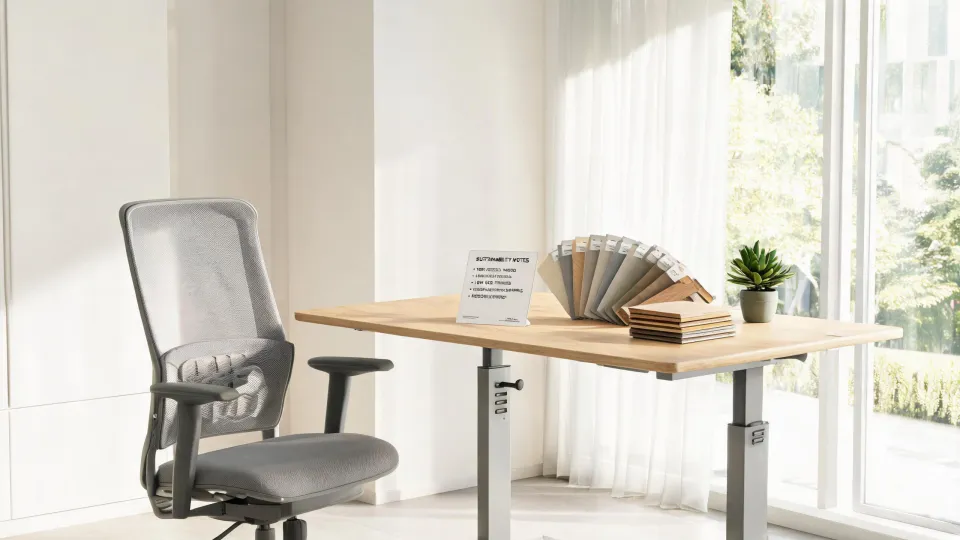
So, bottom line: the best Flexispot standing desk for your office isn't the cheapest one; it's the one that fits your workflow, comes with solid support, and doesn't hide costs in fine print. For us, the E7 three-stage frame ($649 each) outperformed pricier alternatives in stability and warranty. We bought 25 of them. Set up in two days. Zero issues.
One More Thing
Oh, and about printer paper—I should mention that USPS regulations (18 U.S. Code § 1708) don't apply to internal office paper, but if you're mailing marketing materials, the weight and dimensions matter. According to USPS pricing effective January 2025, a First-Class Mail large envelope (1 oz) costs $1.50. We switched to lighter paper for flyers and saved $400 in postage per campaign. That's another $400 you wouldn't see on a unit-price report.
I still have the spreadsheet I built after getting burned on hidden fees twice. It now covers 23 categories from desks to highlighters. If you want a copy, hit me up on LinkedIn. But more importantly: stop looking at price tags. Start looking at total cost. That $200 savings on a chair sneaks up on you when the warranty expires after two years. Trust me.

Jane Smith
I’m Jane Smith, a senior content writer with over 15 years of experience in the packaging and printing industry. I specialize in writing about the latest trends, technologies, and best practices in packaging design, sustainability, and printing techniques. My goal is to help businesses understand complex printing processes and design solutions that enhance both product packaging and brand visibility.