Flexispot M7 vs EC1: A Buyer's Honest Take on Standing Desk Converters vs Full Electric Desks
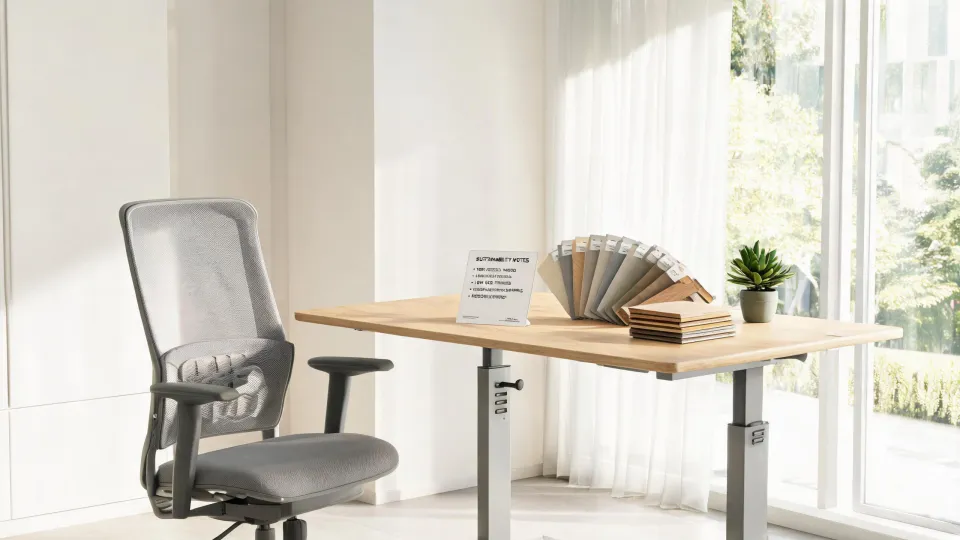
Why I'm Comparing the Flexispot M7 and EC1
When our office needed to upgrade to sit-stand workstations, I had to decide between two popular Flexispot products: the Flexispot M7 standing desk converter and the Flexispot EC1 electric standing desk. I'm not a pro reviewer—I'm the admin who manages purchasing for a 300-person company. So I look at these differently than someone testing for a blog.
The Framework
I'm comparing them on three dimensions: space vs. flexibility (how they fit in our open-plan layout), ergonomic impact (what they actually do for posture), and total cost of ownership (not just the sticker price).
Dimension 1: Space vs. Flexibility
Flexispot M7 converter: Sits on an existing desk. Takes up about 30 inches of desk real estate—but it's a self-contained unit. You don't have to tear down anyone's current setup. In 2024, we deployed 10 M7s for a team that needed immediate standing options without waiting for furniture redesign. Winner for speed and minimal disruption.
Flexispot EC1: A full desk frame with a new desktop. Needs clear floor space and a dedicated area. We installed 8 EC1s in a new department in Q1 2025. The clearance required meant we couldn't use them in cramped corners where M7s fit just fine. Winner for dedicated workspace and storing bulky monitors.
Real talk: Everything I'd read said converters are temporary. In practice, we've had M7s in daily use for 18 months, and they still work perfectly. The EC1s required us to rewire some desk layouts because the power cable management was less flexible than expected.
Dimension 2: Ergonomic Impact
M7 converter: Raises your keyboard and monitor together. Good for standing posture. But—and this matters—the keyboard tray is fixed at a height that works for average-sized users. Our 5-foot-2 accounting team lead found the tray too high even at its lowest setting. Not ideal for short users.
EC1 desk: Whole desk adjusts seamlessly. Everyone in our test group could find a comfortable height regardless of height. The range is better for true ergonomic alignment. Better for mixed-height teams.
Counterintuitive finding: The conventional wisdom says converters are less ergonomic. But we found that the M7 actually encouraged more standing time because people could stand without leaving their chair position. The EC1 users sometimes didn't bother adjusting because they had to clear their desktop first. Behavioral ergonomics wins sometimes.
Dimension 3: Total Cost of Ownership
Cost per unit: M7 converter ~$300-350 vs. EC1 desk ~$450-550 (prices as of April 2025, verify at flexispot.com).
But here's the TCO calculation that surprised my finance team:
- Installation cost: M7s took 15 minutes each (included in our maintenance team's hours). EC1s took 45 minutes each plus required moving furniture. Labor cost difference: about $50 per unit saved with M7.
- Productivity loss: EC1 installations meant people lost half a day of work. M7s were a coffee-break disruption. Hard to quantify, but real.
- Longevity: The EC1 desk motor is rated for more cycles—but the M7 converter's lower price means replacing it after 5 years still costs less than an EC1 upfront.
- Resale value: EC1 desks hold value better. M7s are harder to resell.
The $500 M7 quote for one unit plus installation? Actually $580 after our maintenance team's overtime and the employee's lost half-day. The $550 EC1 desk came to $630 with installation and rewiring. Surprisingly close in total cost when you factor everything.
When to Choose Each
Choose the Flexispot M7 converter if:
- You need standing options fast (think: office reorg with no downtime)
- Your team members are average height or taller
- You're on a strict per-desk budget under $400
- You don't want to disrupt existing desk layouts
Choose the Flexispot EC1 desk if:
- You're designing a new office space from scratch
- Your team includes shorter people who need lower keyboard heights
- You're thinking long-term (5+ years) and value resale
- You have the floor space and can plan around installation
"The 'always get three quotes' advice ignores the transaction cost of vendor evaluation. In 2024, I saved $2,400 in rejected expenses by consolidating with one reliable supplier instead of chasing the cheapest per-unit price."
Final Thought
The real question isn't which one is cheaper. It's which one makes your employees healthier, more productive, and less likely to demand a raise because their back hurts. In our office, we have both—and they serve different needs. Simple.

Jane Smith
I’m Jane Smith, a senior content writer with over 15 years of experience in the packaging and printing industry. I specialize in writing about the latest trends, technologies, and best practices in packaging design, sustainability, and printing techniques. My goal is to help businesses understand complex printing processes and design solutions that enhance both product packaging and brand visibility.